

We asked our naturalists to choose their favorite species in the San Juans, and tell us a little about their connection to them. They chose these whales, and who can blame them. They’re incredible animals.
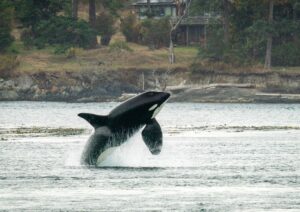
West Coast Bigg’s Killer Whales
Orcas, or killer whales, are a toothed whale in the oceanic dolphin family. Which means they’re technically both whales and dolphins. These 3-6 ton creatures are fascinating, with their own dialects, and apex predator hunting habits specific to matrilineal pods, that are passed down for generations. Orcas are found in every ocean worldwide. However, the most well researched orcas are the ones in our backyard of the Salish Sea. These killer whales are divided into three main subspecies : Offshore, Resident (Southern and Northern), and Transient (Bigg’s).
Where does the name Bigg’s come from?
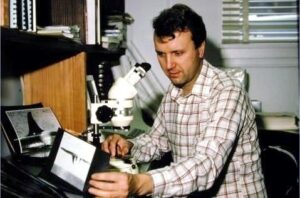
After the capture of almost 50 killer whales from the region of British Columbia and Washington between 1962-73, marine biologist Michael Bigg on behalf of the Canadian government, determined via a revolutionary questionnaire system that there were no more than 350 individuals in the Salish Sea. Much smaller than previously thought. He recommended the population was much too low for any harvesting or hunting. The US government followed up with their own survey, and soon public sentiment changed from fear of the animal to fascination, and no killer whale has been taken from BC or WA waters since 1976.
Experts are now encouraging the term “Bigg’s killer whales” over “Transient orcas”, obviously in honor of Bigg, but also because the species is growing less and less transient. Bigg’s orcas feed on marine mammals, which are plentiful here, and therefore they tend to stick around the area more than their sister Salish Sea species, the Southern Resident Killer Whales who are now the more transient species, as the salmon they feed on are dwindling in the region, and are much less often seen here. We do not watch them. The SRKW’s and the Bigg’s have not interbred for 100s of thousands of years. The SRKW’s are endangered with less than 75 individuals as of 2023, but the Bigg’s population is around 400 individuals and thriving.
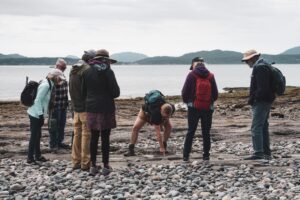
Orcas have a special place in the heart of our long-time naturalist Kara Drovdahl. She first saw them at age 4 on a whale watch, and loved drawing them in school notebooks. Kara took a summer course at Oregon Coast Aquarium where she was able to witness preparation of “Keiko”, the star of Free Willy, for an unprecedented attempt at release back into the wild via a flight back to Iceland. After moving to Bellingham and joining San Juan Cruises, Kara has enjoyed many interesting encounters with resident and Biggs orcas. Kara said, “People give them nicknames and can tell stories of the orcas’ families and life, and I just think that gives them such a connection to us as people, out on the water.”
Humpback Whales
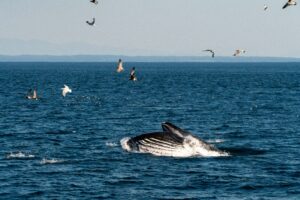
Another whale found worldwide, and frequently in the Salish Sea, is the humpback. This baleen whale (baleen is a filtering system alternative to teeth), is over twice the size, and five times the weight of an orca at 40 tons, sporting pectorals that are some of the longest appendages in the whole animal kingdom. Males can produce a unique song from 4-30 minutes long. The whales that come to the Salish Sea to feed and wander, will travel over 2000 nautical miles between Alaska in the summer to feed, and Maui and Mexico in the winter to breed; humpbacks are the snowbirds of the ocean. After being hunted to almost extinction in the Pacific Northwest region in the early 1900’s, the now famous individual, Big Mama has helped repopulate the area over the last few decades, to over 5,000 individuals having visited the area since.

Emily, one of our naturalists for the last three years, chose humpbacks as a favorite species. She said, “I am constantly amazed by their sheer size and life history. They are the acrobats of the sea, and there is nothing more jaw dropping than seeing a fully grown humpback whale breach. They are so beautiful and unique, with their long pectoral fins and massive flukes.”
We were able to see a humpback lunge feed this season, and it was quite breathtaking seeing their massive mouth burst out of the water.
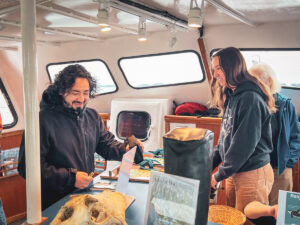
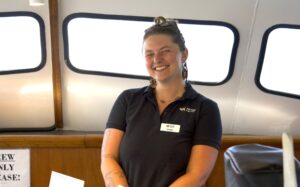
Emily Lekburg and Lauren Rasmussen, naturalists on the Victoria Star 2
Lauren, our new-to-us but highly experienced naturalist, said her favorite species is the humpback too. She says their pleated underbelly has interesting textures that are fun to recreate in her art. She also remarked on their capacity for empathy and altruism. She shared a wild story: “Nan Hauser, a whale researcher, was working on a conservation film in Rarotonga when a humpback approached her, gently pushing her through the water. What Nan hadn’t yet realized was the 18 ft tiger shark nearby. The humpback got her on top of his head, nudging her back towards her boat and to safety.” They are also impressive simply for their sheer size, Lauren and Emily agree.
Truly fascinating creatures orcas and humpbacks. We’re deeply lucky to be able to see them only a few dozen miles away from our home base in Bellingham, Washington. We pride ourselves in sustainable, responsible whale watching. We adore these whales, and strive to see them thrive for decades to come.