

Orcas

In an area famous for orca whales, one might assume this island is named for them. However it is a total coincidence. The name “Orcas” is a nickname derived from the full name: Juan Vicente de Güemes Padilla Horcasitas y Aguayo, the Viceroy of New Spain (pre Mexico) who sent Francisco de Eliza to the area, discovering it in 1791. It is uniquely upside-down U shaped, separated in the middle by East Sound. This sound brings ends at the island’s village of Eastsound, the largest population center on Orcas and the second largest in San Juan County.
Mount Constitution, elevation 2,409 feet (734 meters), is the highest point in the San Juan Islands. The mountain is the centerpiece of Moran State Park, the largest recreation area in the San Juans, and the largest State Park in Washington.
The state supports island access through the Washington State Ferries system. Although the ferry docks do not provide direct access to the town of Eastsound, so driving on is usually recommended. While we don’t run trips to Orcas ourselves, we often end up circumnavigating it as we search for whales, because of its location in the middle of the islands, and east of Bellingham. It often makes for a stunning backdrop for wildlife sightings. Our whale watching trips being in May, and go daily all summer.
Check out our whale watching tours here!
San Juan
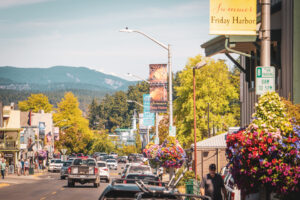 San Juan Island is appropriately named as the population and tourism center of the San Juan Islands, as well as the San Juan County seat, and hosting the only incorporated town in the islands, Friday Harbor. It is the second-largest, only slightly behind Orcas Island, and most populous of the San Juan Island archipelago with a population of 8,632 as of 2020.
After Francisco de Eliza discovered the area for New Spain in 1791, both the British and Americans asserted control of the island over the course of the 1800’s. The dispute reached a climax when an American settler shot a Hudson Bay Company pig, starting the “Pig War” in 1859. By 1861 though, the HBC decided to give up their farm due to reduced morale by soldiers and a lack of British government support. The island was finally fully declared as belonging to the US in 1872 by Kaiser Wilhelm of Germany who was chosen as an outsider to divide up the area between the British and the Americans.
The quaint, fun town of Friday Harbor is our quintessential shore stop, going frequently each summer for day trips, with 3 hours to explore the town. There are plenty of interesting places to check out, including restaurants, breweries, museums and more.
Learn about our trips to Friday Harbor here.
Sucia
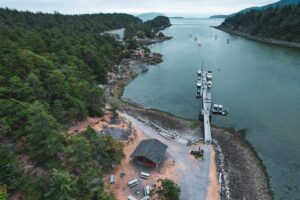 Sucia Island is the largest of the Sucia archipelago of ten islands, within the San Juan archipelago of 175 islands. (Over 700 small islands and reefs can appear at low tide.) The name comes from Spanish Captain Francisco de Eliza, including it on his 1791 map. Sucia is Spanish for “dirty”, a name chosen, because the shore was deemed dangerous for it’s many hidden rocks and reefs. The group of islands is also designated as a Washington state park.
These many reefs and rugged shores come from folding of the Earth’s crust over millions of years, and so many marine fossils were brought to the surface. Some good examples can be found on the southeast arm of Sucia Island, along aptly named Fossil Bay. In 2012, paleontologists collected the first dinosaur bone ever found in Washington state, on Sucia Island. They purport it to be in the tyrannosaurid family, making it a close cousin of Tyrannosaurus rex. The fossil is now in storage at the Burke Museum in Seattle.
We host a few day trips a week every summer to Sucia Island, including an optional guided tour of the fossils on Sucia.
Check out and book a Sucia Island Picnic Day Cruise.
Spieden
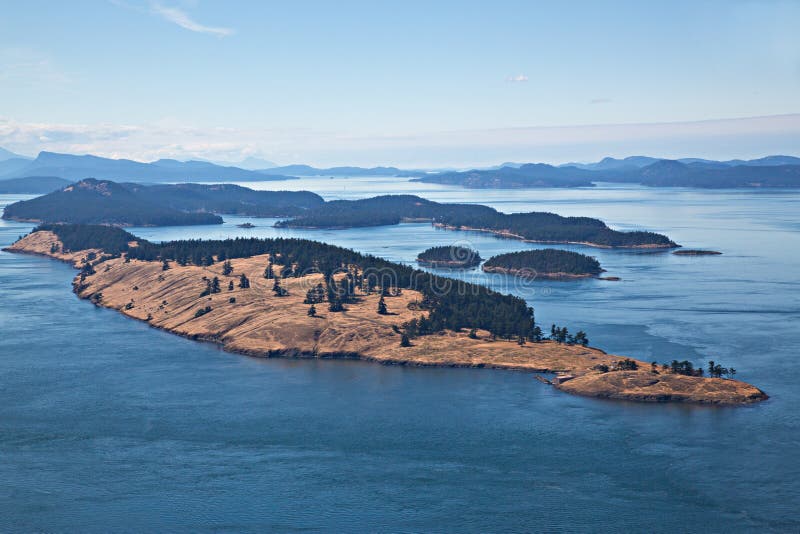 Spieden Island is a privately owned island in the northwest of the San Juans. It has a land area of just 500 acres, and no permanent resident population. The island was purchased by James Jannard, founder of Oakley, Inc. in 1997.
In the 1970s & 80s, the island was used for big game hunting; importing non-native game animals such as Mouflon sheep from Corsica, Fallow deer from Europe, and Sika deer from Asia – along with approximately 2,000 exotic birds. A hunting lodge, airstrip, and small hangar were built. The venture was short-lived, due to environmental concerns and risk of stray gunshots reaching populated areas of nearby San Juan Island. The imported species continue to survive on the island.
We often catch up with whales and other wildlife near Spieden. It makes for an nteresting backdrop with its stark rise to 375 feet elevation on an only two mile island, and the north side being fully forested, contrasting with the south side being mostly barren and featuring glacial erratics, boulders deposited by glacial activity.
Check out our Friday evening whale watches, new this year.
Shaw
 Shaw Island is the smallest (less than 8 sq mi or 20 sq km) of the four San Juan Islands served by the Washington State Ferries, with a small year-round population of less than 200. Although, during the summer time, weekends bring temporary residents and an occasional tourist. The island has the longest-running school in Washington since 1891.
Three institutes of nuns have made Shaw their home: Benedictine nuns established a monastery in the 1970s, the Sisters of Mercy have owned an unofficial retreat on the island since the 80s, and Franciscan Nuns ran the island’s only store and the ferry terminal for almost three decades until 2004, when they relocated.
Despite it’s small size and popularity, it is in the geographic center of the archipelago, and therefore we end up sailing around it fairly often on our whale watching excursions. This of course depends on where the whales that day. We stay in touch with our fellow whale watch outfits of the Pacific Whale Watch Association each day, to share reports of whale sightings, so everyone can share time with the animals. We pride ourselves on sustainable whale watching, following all regulations, and notifying recreation boaters of the presence of wildlife.
All the info on our daily summer whale watch tours.
Come explore these and many other fun summer cruises, including shorter evening beer and wine tastings, crab lunch and dinner cruises, bird watching and more at whales.com